
Introduction
Artificial Intelligence (AI) has become an integral part of various fields, and academia is no exception. From enhancing learning experiences to streamlining administrative tasks, AI tools are transforming the educational landscape. This article delves into the top 10 academic AI tools that are making a significant impact in education, offering insights into their features, benefits, and applications.
Top 10 Academic AI Tools
🥇 1. Elicit
Website: https://elicit.com
Description:
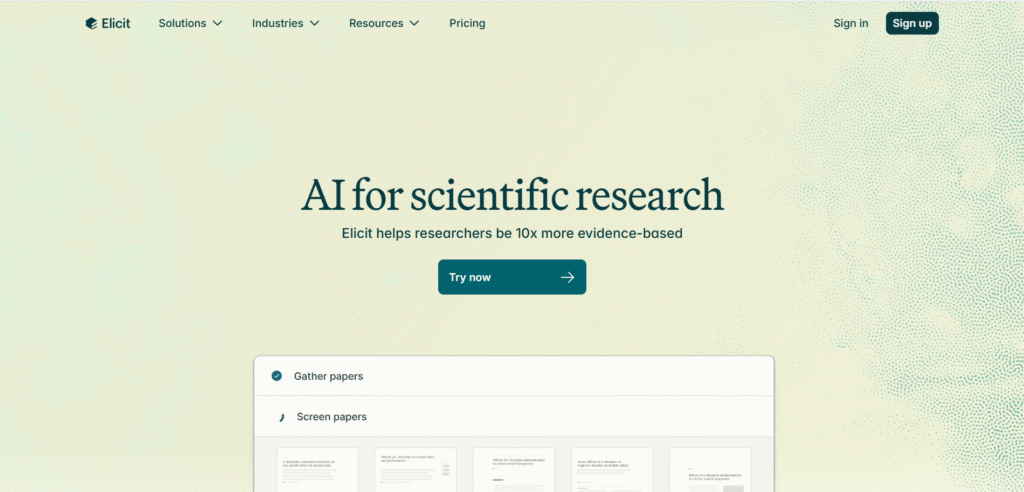
Elicit is one of the most powerful AI research assistants designed specifically for academics. It helps you find, analyze, and summarize research papers — even if you’re not sure where to start.
Unlike standard search engines, Elicit allows you to ask questions in plain language (e.g., “What are the effects of meditation on stress?”), and it fetches relevant peer-reviewed papers with summaries of methodology, sample size, and findings.
It also provides structured tables comparing studies side-by-side, making literature review much easier.
Best For:
Students, researchers, and data analysts conducting systematic reviews or meta-studies.
Highlights:
- Semantic paper search (not keyword-based)
- Summarizes study findings and methods
- Extracts data like variables, populations, outcomes
- Export results into Excel or Notion
🥈 2. SciSpace (formerly Typeset)
Website: https://scispace.com
Description:
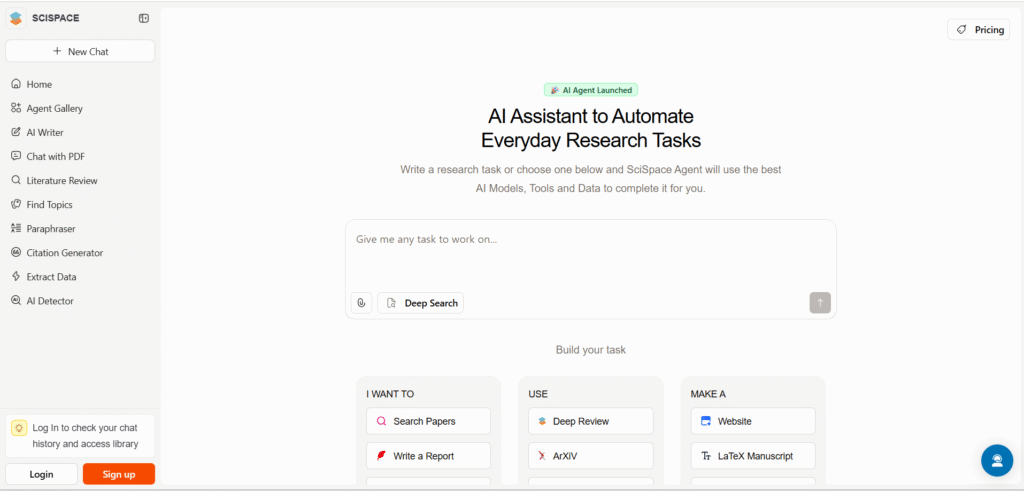
SciSpace is a complete academic ecosystem that helps you search, read, and write research papers — all in one place.
Its “Copilot” feature allows you to chat with academic PDFs, summarize sections, explain equations, and even generate citations automatically.
You can upload any research paper, and SciSpace will instantly explain jargon, interpret figures, and point you to related work.
Best For:
Graduate students, researchers, and educators reading dense technical papers.
Highlights:
- AI chat with research papers
- 270M+ scholarly articles indexed
- Paraphrasing and summarization built-in
- Reference manager + export to BibTeX
🥉 3. Paperpal
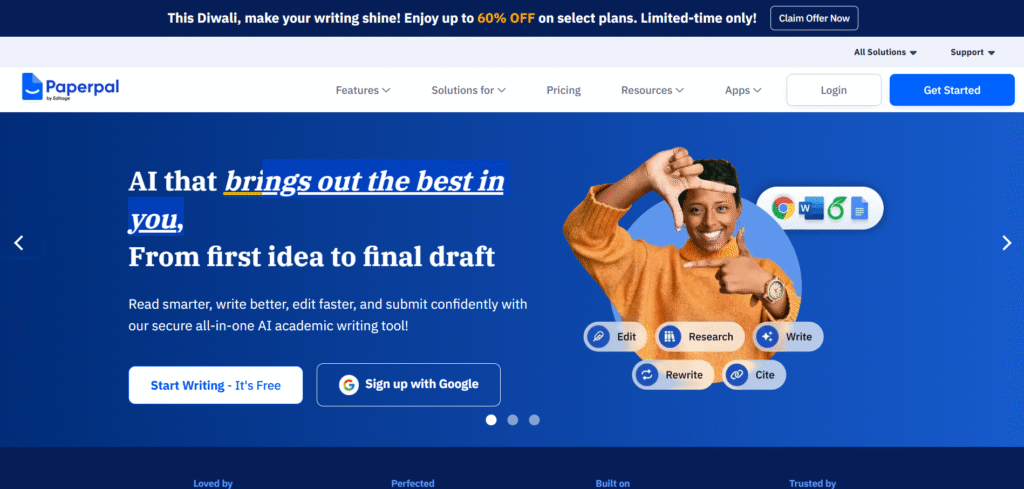
Website: https://paperpal.com
Description:
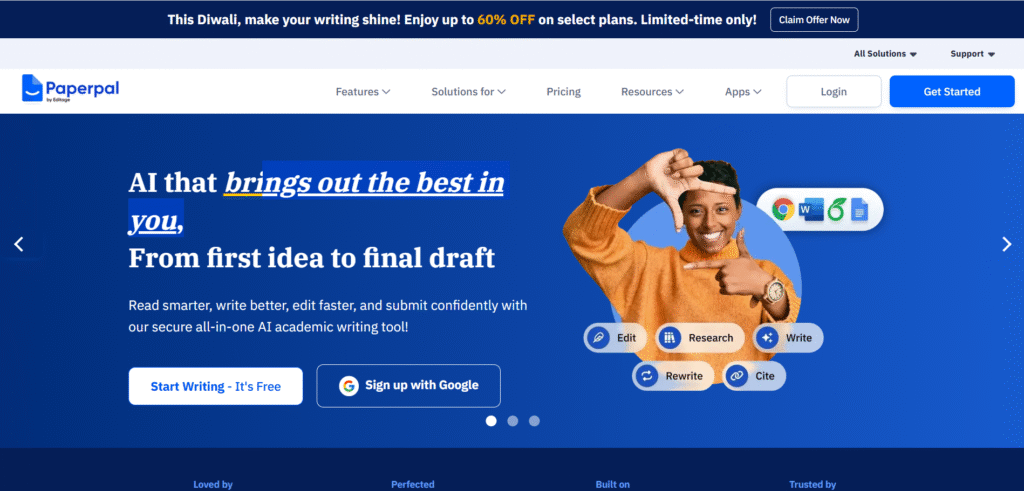
Paperpal is an AI academic writing assistant built for researchers who want to improve clarity, tone, and grammar while maintaining academic rigor.
It’s trusted by publishers like Springer and Taylor & Francis because it’s specifically trained on academic writing standards.
Paperpal not only fixes grammar but also provides suggestions for sentence structure, conciseness, and academic tone, ensuring manuscripts meet journal submission criteria.
Best For:
Researchers and authors preparing manuscripts for publication.
Highlights:
- Academic grammar and tone correction
- Context-aware paraphrasing
- Integration with Microsoft Word & Overleaf
- Checks for journal-readiness
4. Scite.ai
Website: https://scite.ai

Description:
Scite goes beyond simple citation counts — it uses AI to analyze how a paper is cited: whether supporting, contrasting, or mentioning a previous work.
This unique approach lets researchers evaluate the credibility of claims in the literature rather than just popularity.
You can also use Scite Assistant to explore research debates or track the evolution of an idea.
Best For:
Academics validating sources, researchers conducting literature reviews.
Highlights:
- Citation classification (supporting / contrasting)
- Interactive citation graphs
- Browser extension for Google Scholar
- Integrates with Zotero and Mendeley
5. Jenni AI
Website: https://jenni.ai
Description:
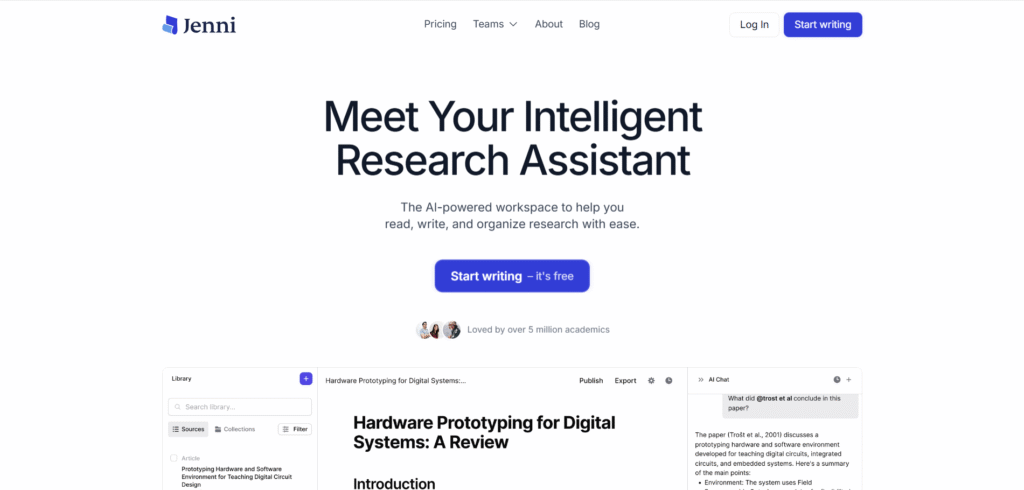
Jenni AI is an academic writing copilot that helps you write essays, reports, or research articles more efficiently.
You can start with a blank page, and Jenni will help generate coherent sections, suggest citations, and even adapt tone or structure for journals.
It integrates seamlessly with APA, MLA, and Chicago-style citation formats, making it great for students or academics writing dissertations.
Best For:
Students, thesis writers, and academic authors.
Highlights:
- Context-aware writing assistant
- In-text citation suggestions
- Supports academic formatting styles
- Works in Word and browser-based editors
6. Semantic Scholar
Website: https://www.semanticscholar.org
Description:
Semantic Scholar is an AI-powered academic search engine developed by the Allen Institute for AI.
It uses semantic understanding to surface relevant, high-impact research instead of just keyword matches.
Its “TLDR” feature gives one-sentence paper summaries, while its citation graph visualizes how studies connect over time.
Best For:
Anyone conducting literature searches across disciplines.
Highlights:
- 200M+ papers indexed
- AI-powered relevance ranking
- Citation graph visualization
- One-line paper summaries
7. STORM (AI Research Tool)
Website: https://storm-research.ai
Description:
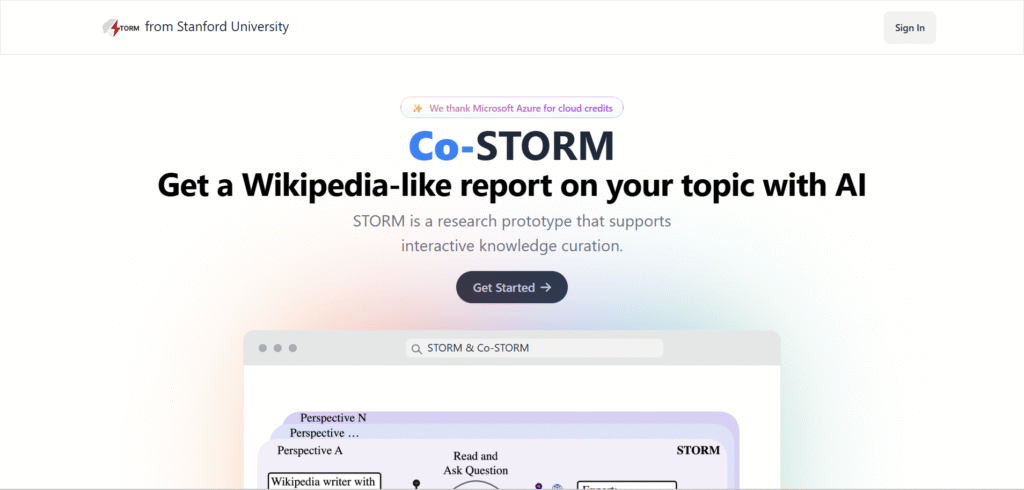
STORM is an emerging AI-assisted knowledge synthesis platform that generates structured overviews and summaries from large data sources.
It uses retrieval-augmented generation (RAG) to ensure all claims are backed by verified citations — ideal for survey papers and background research.
Best For:
Researchers conducting literature reviews or writing background sections.
Highlights:
- Structured overview of topics
- Verified citations with each claim
- Dynamic topic expansion
- Academic-style output
8. MetaInfoSci
Website: https://arxiv.org/abs/2506.09056

Description:
MetaInfoSci is an AI-powered bibliometric and research analytics tool for academic professionals.
It analyzes large publication datasets to reveal trends, citation networks, and collaboration clusters.
You can use it to track your field’s growth, identify emerging topics, or visualize who’s collaborating with whom globally.
Best For:
Research analysts, university librarians, and policy advisors.
Highlights:
- Bibliometric mapping
- Citation trend analysis
- Co-authorship and keyword networks
- Integration with Scopus & Web of Science
9. ARDIAS
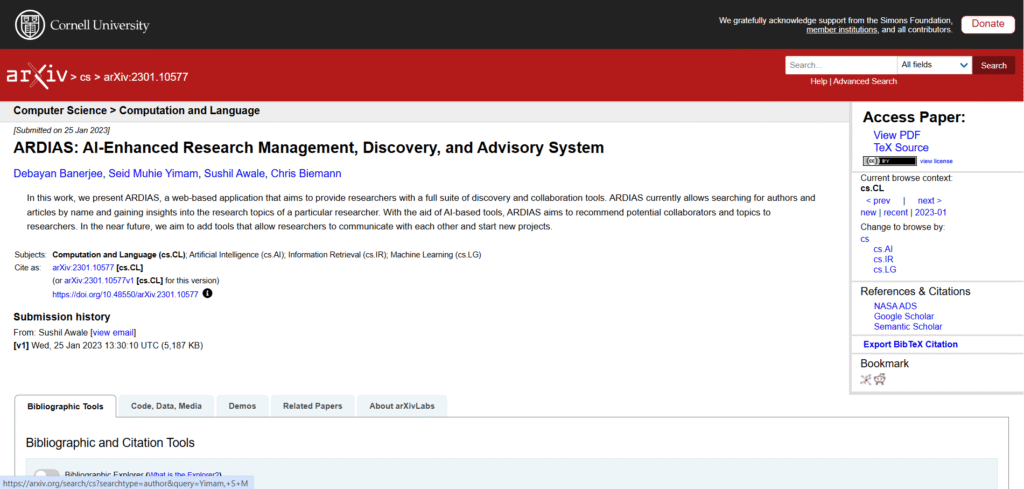
Website: https://arxiv.org/abs/2301.10577
Description:
ARDIAS (AI Research Discovery and Analysis System) is an intelligent research management tool that uses AI to identify potential collaborators, related topics, and unexplored subfields.
It also predicts emerging trends and research opportunities, making it useful for institutions or researchers planning long-term projects.
Best For:
Academic strategists, research teams, and funding organizations.
Highlights:
- AI-driven topic modeling
- Collaboration and author discovery
- Predictive research analytics
- Research portfolio management
10. Authorea
Website: https://www.authorea.com
Description:
Authorea is a collaborative writing and publishing platform designed for researchers.
It supports LaTeX, Markdown, and live data embedding, allowing co-authors to work together in real time while maintaining academic formatting.
Researchers can also publish preprints or open-access articles directly from the platform.
Best For:
Teams writing research papers, preprints, or technical reports.
Highlights:
- DOI and open-access publishing options
- Live collaborative editing
- Code and data embedding in papers
- Automatic citation and formatting
FAQs
What are the benefits of using AI tools in academia? AI tools in academia offer personalized learning, streamline administrative tasks, enhance academic integrity, and improve overall learning experiences.
How does Grammarly help students? Grammarly helps students by checking grammar, punctuation, and style, providing suggestions for improvement, and detecting plagiarism.
Can AI tools replace traditional teaching methods? AI tools complement traditional teaching methods by providing additional resources, personalized learning experiences, and efficient administrative support.
Are AI tools like Coursera and Khan Academy recognized by employers? Yes, many employers recognize certifications from Coursera and the knowledge gained from Khan Academy, valuing the skills acquired through these platforms.
Is Turnitin effective in detecting all forms of plagiarism? Turnitin is highly effective in detecting most forms of plagiarism, but it is essential for students to understand and practice proper citation and referencing.
How does Socrative enhance classroom engagement? Socrative enhances classroom engagement by allowing teachers to create real-time quizzes and polls, providing instant feedback, and encouraging interactive learning.
Conclusion
AI tools are revolutionizing the academic landscape, offering innovative solutions to enhance learning, streamline administrative tasks, and maintain academic integrity. The top 10 academic AI tools highlighted in this article demonstrate the diverse applications and significant benefits of AI in education. By leveraging these tools, students, educators, and institutions can achieve better educational outcomes and create a more engaging and effective learning environment.